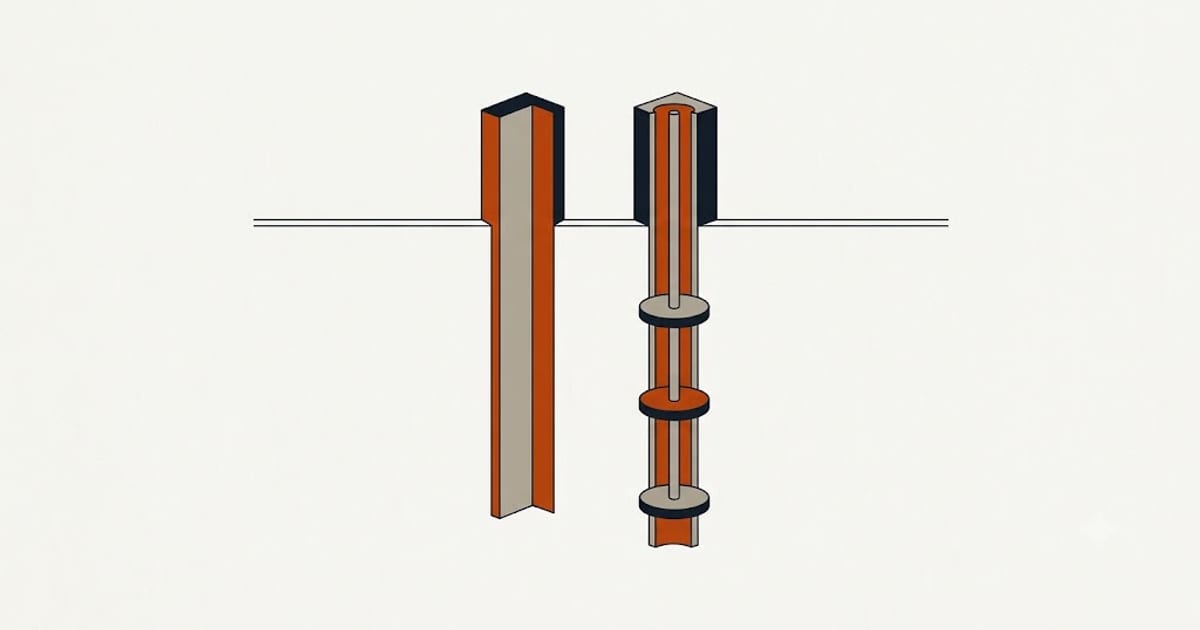
Both carry the foundation down to soil that can hold it. They get there differently, and the difference decides which suits a given house.
Push piers
Steel tube sections driven vertically using the weight of the building itself as the reaction force, through a bracket bolted to the footing. Sections are added until the pier reaches load-bearing strata or refusal.
They need weight to work. A heavy two-storey brick house provides plenty of reaction; a light single-storey frame house may not, and the pier can stop short of competent soil while appearing to be at refusal.
They can go very deep — sometimes 30 feet or more — which is exactly what you want where the good soil is a long way down.
Capacity is proven by the driving pressure, correlated to the load the house supplied.
Helical piers
A steel shaft with helical plates welded along it, screwed into the ground by a hydraulic torque head. The plates bear on soil rather than the tip.
They do not need the building's weight. Torque comes from the machine, so they work under light structures, and they can be installed before a structure exists — new construction, decks, additions.
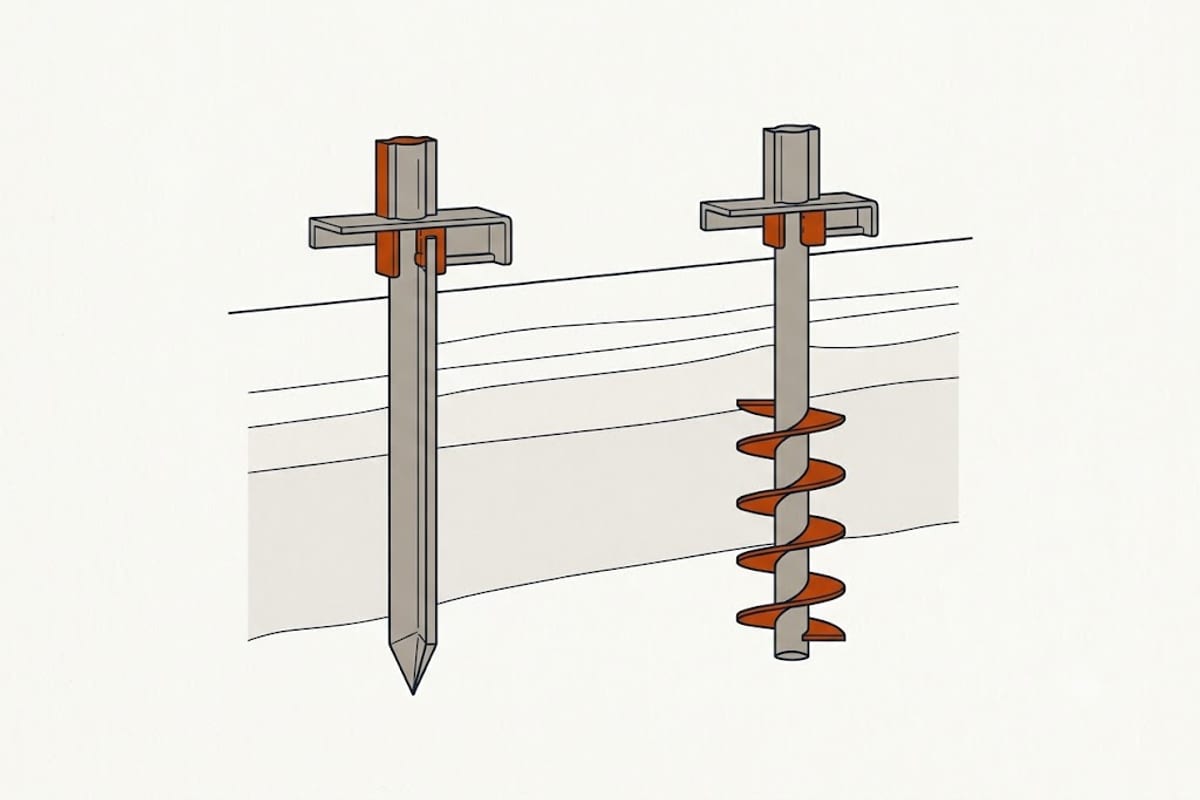
Capacity is measured as they go. Installation torque correlates to capacity, so the installer knows what each pier will hold at the moment of installation rather than inferring it. That is a real engineering advantage and the strongest argument for them.
They can be loaded immediately and removed and reused, which matters on temporary works.
What actually decides it
| Push piers | Helical piers | |
|---|---|---|
| Heavy structure | ideal | fine |
| Light structure | may under-drive | ideal |
| Very deep bearing stratum | better | limited |
| Verified capacity per pier | inferred | measured by torque |
| New construction, no load yet | not possible | standard |
| Rocky or obstructed soil | can deflect | can refuse early |
Cost per pier is broadly similar — the difference between them is rarely what moves a quote.
The question to ask
"Which do you install?"
A contractor who installs only one type will recommend that one for every house, and they will have a fluent explanation ready. That is not dishonesty; it is what having one crew and one machine does to an assessment.
The way through it is an independent structural engineer's report specifying the system before the bids go out. On a job in this price range it costs a small fraction and it converts three incompatible opinions into three prices for the same work.
What "refusal" means, and why it is worth asking about
Both systems stop when they meet resistance. What that resistance is differs, and it is the most common way a pier underperforms.
A push pier stops when the driving pressure balances against the weight the building can supply. On a light structure that can happen in soil that is merely firm rather than load-bearing — the pier appears to be at refusal because the house ran out of weight, not because the ground got strong. The record to ask for is the driving pressure at each pier and what depth it reached.
A helical pier can hit a boulder or a dense lens and register high torque prematurely. Torque correlates to capacity in uniform soil; an obstruction gives a reading that flatters the pier.
In both cases the defence is the same: installation records per pier, showing depth and pressure or torque. Any competent contractor produces them as a matter of course, and a job where they are unavailable afterwards is a job you cannot evaluate.
What matters more than the type
Depth to competent soil, which comes from a soils report or from the driving records of nearby work.
Whether the scope is stabilise or lift, which changes the price and the outcome, and which should be written down.
Whether the drainage gets corrected. Most residential settlement is moisture-driven — expansive clay shrinking in drought and swelling after rain, or a downspout that has discharged against the footing for twenty years. Piers installed under a house whose water has not been dealt with hold that section while the untreated sections keep moving.
What the warranty excludes. Nearly all pier work carries a transferable lifetime warranty on the piers. The exclusion to read is further movement in areas that were not piered — which is precisely what happens when only the visibly cracked wall gets done.