Total settlement — how far the whole house has gone down — matters much less than people expect. A house that settled uniformly by three inches has cracked very little, because nothing is being bent.
What causes damage is differential settlement: one part dropping relative to another. And what measures it is a ratio.
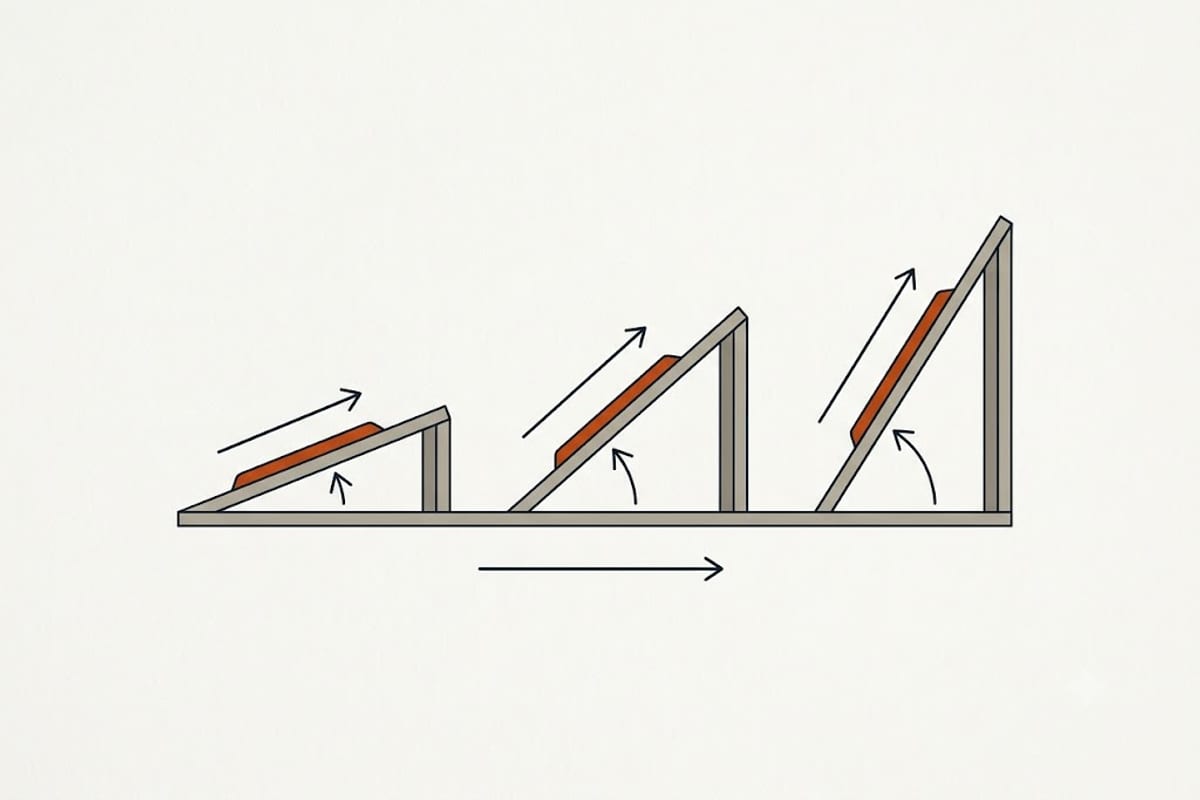
Angular distortion
angular distortion = difference in elevation ÷ distance between the two points
Commonly cited thresholds:
| Ratio | Typically associated with |
|---|---|
| 1/500 | No visible damage |
| 1/300 | Architectural cracking begins |
| 1/250 | Doors and windows binding |
| 1/150 | Structural concern |
These are guidance rather than code, and they vary with construction type — brittle finishes like plaster and tile show damage earlier than drywall, and masonry earlier than timber frame.
What the ratios mean in inches
Over 20 feet (240 inches):
- 1/500 ≈ 1/2 inch
- 1/300 ≈ 3/4 inch
- 1/150 ≈ 1 1/2 inches
Over 8 feet (96 inches):
- 1/300 ≈ 1/3 inch
- 1/150 ≈ 2/3 inch
Which is the point. The same absolute drop is trivial across a long span and serious across a short one.
Measuring it
A manometer or a laser level, taking floor elevations on a grid across the whole floor and recording them on a plan.
A phone level on the floor is not adequate — it measures local slope, and floors are not flat locally for many reasons unconnected to the foundation.
A single measurement is a snapshot. Two measurements a year apart tell you whether it is moving, and that is the question that decides whether anything needs doing.
Rate matters as much as amount
A house that settled two inches in 1974 and has not moved since needs monitoring and nothing else. A house that has moved half an inch in the last twelve months needs attention now, even though the total is smaller.
This is why an old house with old cracks is frequently fine and a new house with new cracks is not. New construction on poorly prepared fill can move fast.
Symptoms, roughly in order of appearance
Hairline cracks at the corners of openings. Doors that need a firm push. Cracks in tile grout. Gaps at the top of interior door frames. Windows that stick. Visible slope with a marble. Gaps between wall and ceiling. Doors that will not latch at all.
By the time a marble rolls noticeably, angular distortion is well past 1/300 somewhere.
When it is worth acting
The combination that argues for repair is measurable differential settlement, evidence that it is progressing, and functional damage. Any one of the three on its own usually argues for measuring again in a year.
The combination that argues for urgency is a horizontal crack or a bowing wall, which is a different mechanism entirely and is not about settlement at all.
What a structural engineer adds
An engineer will take elevations, look at the cracking pattern, consider the soil and the drainage, and give an opinion on cause, severity and whether the movement is active.
That opinion also produces a defined scope, which is what makes contractor quotes comparable. On a house where the answer might be "monitor for a year", it is also the only opinion in the process that does not come from someone selling piers.
Construction type changes the threshold
The ratios above are general. What they mean on a specific house depends on what the house is made of.
Brittle finishes — plaster, ceramic tile over mortar, stone — crack at smaller distortions than drywall and vinyl. A house with original plaster shows damage at ratios where a modern drywall house shows nothing.
Masonry and brick veneer crack earlier than timber frame with siding, because the cladding has no ability to accommodate movement.
Slab on grade distributes differently from a crawl space or basement foundation, and a slab that cracks has cracked permanently, where a timber floor over a crawl space can be re-levelled from below.
That variation is why an engineer looks at the building as well as the numbers, and why the same measured distortion produces different recommendations on different houses.
New build against old house
A house that has been standing for fifty years has finished most of the settlement it is going to do under its own weight. Movement appearing now has a new cause, and finding the cause matters.
A house built in the last few years is still consolidating, particularly if it sits on engineered fill. Some movement in the first years is expected, and the builder's warranty may cover it — which is worth checking before paying for a repair yourself.